On the evening of March 14, the first 2026 weekend fireworks show at Liuyang Sky Theater lit up the spring night sky.
It was a nearly windless evening. In the past, such weather often meant smoke lingering above the river after fireworks displays, leaving a gray veil over the sky.
But that night, something was different.
Golden waterfalls cascaded downward, crimson peonies bloomed in the sky, and blue meteors streaked across the darkness. After each explosion, the smoke quickly dispersed, and the sky returned to crystal clarity.
Standing beside the stage, Zhou Zhengjiang, chairman of Liuyang Xiangxing Premium Fireworks Export Manufacturing Co., finally relaxed when the last aerial shell rose into the sky.
“This was the first weekend fireworks show of 2026 — and a major test of the micro-smoke, sulfur-free fireworks products we’ve spent years developing,” he said.
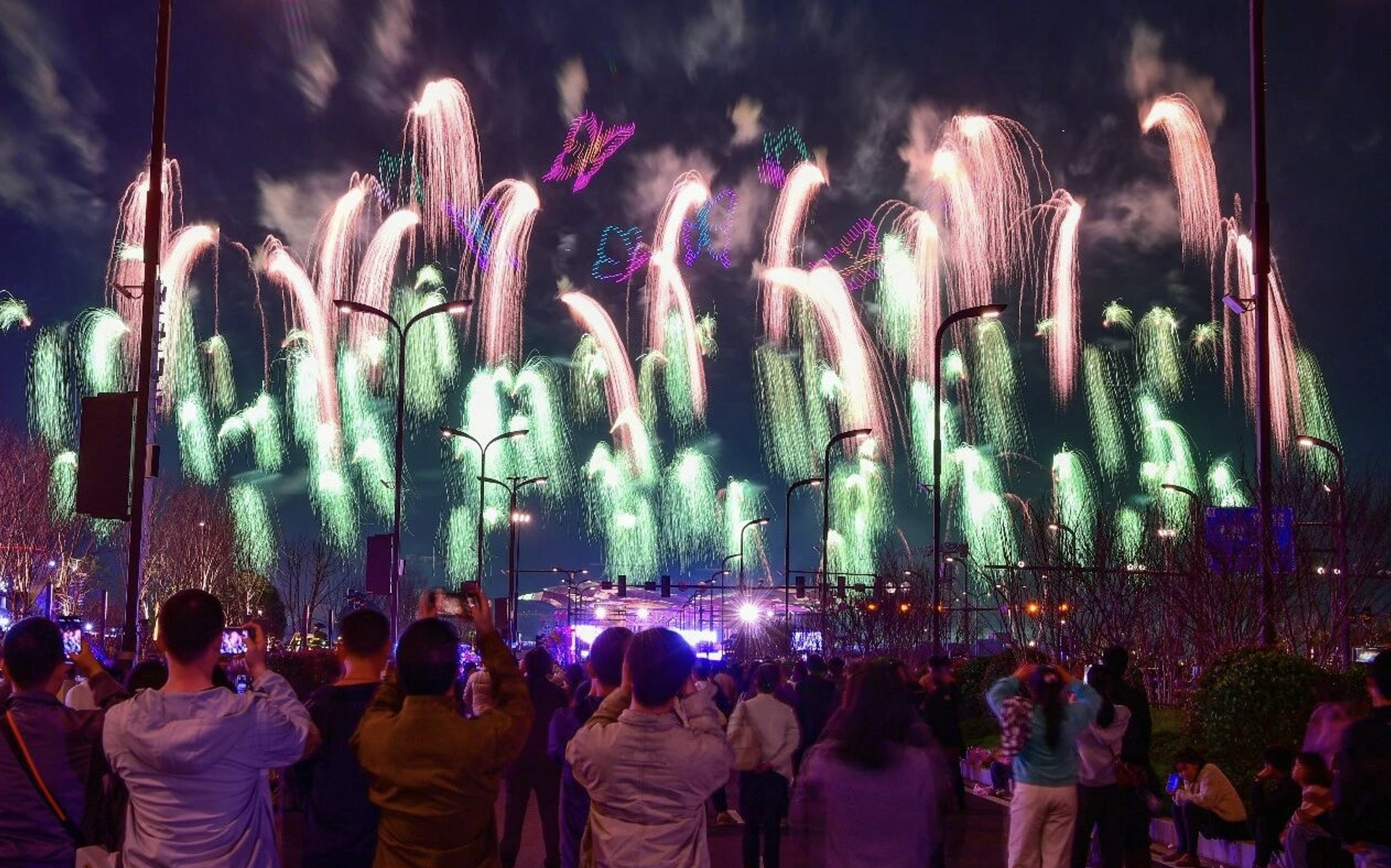
Micro-Smoke, Sulfur-Free Fireworks Light Up Spring
At 7:38 p.m., a digital countdown created by special-effect fireworks illuminated the sky, officially opening the show titled “Together Toward Spring.”
The performance followed the rhythm of nature, unfolding through four themed chapters:
Spring Thunder – Silver fireworks shot skyward like lightning, symbolizing awakening energy.
Spring Rain – Soft red, pink, and pale green sparks gently drifted downward, while mid-air fireworks formed a towering “tree of life,” representing renewal.
Spring Breeze – Flowing fireworks swirled like ribbons and rolling waves.
Spring Rhythm – A finale of vibrant red, orange, yellow, and green fireworks filled the sky like blooming spring flowers.
Thousands of drones joined the display, forming dynamic images such as blossoming flowers, fluttering butterflies, and rising hot-air balloons — creating a vivid springtime atmosphere.
But the show’s most notable feature was environmental protection.
More than 4,000 fireworks products used during the show were micro-smoke, sulfur-free designs developed by Xiangxing Fireworks, accounting for over 60% of the total.
“We deliberately avoided traditional combination fireworks,” Zhou explained. “Instead, we focused on premium aerial shells and sulfur-free stage fireworks.”
The result reduced smoke by around 90%, making the patterns clearer while protecting the night sky.
“Our goal is to reduce smoke at the source — delivering a visual spectacle while keeping the sky clean and achieving harmony between fireworks and nature.”
Several new eco-friendly products made their debut, including the “Multicolor Gem” fountain series, which sprays vibrant blue, purple, red, white, and silver sparks in rhythmic patterns.

Two Decades of Research and Technical Breakthroughs
In Xiangxing Fireworks’ factory in Dahu Town, production lines are running at full speed. Orders have already been scheduled through August, thanks to strong export demand.
The company’s story dates back to 2000, when founder Zhou Jian, a veteran fireworks technician, decided to start a business focusing on cold fireworks — a niche category used for indoor events and stage performances.
Unlike traditional fireworks, cold fireworks are often used close to audiences, meaning strict requirements for smoke, smell, and safety.
Traditional fireworks rely on sulfur in propellants and bursting charges to produce bright colors and loud explosions. But burning sulfur generates sulfur dioxide, the main source of smoke.
The challenge: Could sulfur be replaced with more environmentally friendly materials?
After extensive experiments, the team introduced retired single-base propellant, which burns more completely and produces less smoke. However, this created another issue — strong odor.
To solve it, the team conducted hundreds of experiments, adjusting oxidizers, adding fragrances, and refining material ratios.
Innovation came with risks. Zhou Zhengjiang’s brother Zhou Zhengkai, who now leads R&D, still bears a scar on his arm from a laboratory combustion accident.
“Changing materials affects burn time, color saturation, and ignition duration,” he said. “Developing eco-friendly fireworks is a marathon.”

From Technology Breakthrough to Market Adoption
Through years of research and collaboration with universities such as Nanjing University of Science and Technology and the National University of Defense Technology, Xiangxing Fireworks has developed multiple green technologies, including:
Catalyst replacements for oxidizers to reduce odors
Pull-ignition fountain designs for more complete combustion
Low-temperature sol-gel forming processes to ensure uniform material mixing
Today the company holds 48 national patents (including 10 invention patents) and exports its products to Germany, Switzerland, France, the UK, the United States, Australia, Singapore, and Thailand.
Its fireworks have appeared at major events including the Nanjing Youth Olympic Games, film productions such as “The Battle at Lake Changjin,” and even international events like the Paris Olympic Games.
Yet challenges remain.
Eco-friendly fireworks cost about 40% more than traditional products due to higher raw material costs and limited supply chains.
Consumer awareness is also evolving slowly.
“For years, buyers focused mainly on sound and size,” Zhou said. “Environmental protection is still a new concept for many consumers.”
Toward a Greener Future for Fireworks
Liuyang is actively promoting the transition to micro-smoke and sulfur-free fireworks technologies.
The city has established dedicated research programs and founded the Hunan Liuyang Fireworks Science Research Institute, bringing together more than 30 fireworks companies and 20 universities to work on 27 scientific projects, including new low-smoke materials and environmentally friendly formulations.
Government support and corporate innovation are building momentum for a greener industry.
Xiangxing Fireworks is already developing next-generation materials such as nitrocellulose and ultrafine cellulose to replace traditional propellants, aiming for even cleaner fireworks effects.
“The breakthrough has been made,” Zhou said. “Now the challenge is expanding market adoption.”
For Liuyang — the world’s fireworks capital — the future of fireworks may not only be brighter, but also greener.